by: Scott Granger - Mission Architectures Intern at Aerojet and MEng Student
This summer I had the opportunity to work at Aerojet in Sacramento, CA. Aerojet is a defense contractor mainly for spacecraft, launch vehicle, and missile propulsion systems. Aerojet has two main competitors – Pratt & Whitney Rocketdyne and ATK. What makes Aerojet so unique is they are the only company that have experience in liquid, solid, and electric propulsion.
I spent 13 weeks in Sacramento, CA working on two main projects. I sat in the Mission Architectures Group which performed the up-front feasibility studies for propulsion systems. The work that is done in this group eventually is the basis for determining the requirements of the system – should the customer give us their business. On the job, I was first introduced to a trajectory simulation tool called POST. POST is a FORTRAN based code (though compiled through an executable) that determines the best trajectory for a launch vehicle based on different propulsion systems. You can set different constraints on the problem to limit, for example, dynamic pressure during staging. A large part of my summer was spent running POST simulations for different launch vehicles composed of many different propulsion systems. Second, I was assigned as the head engineer on a small contract with Sierra Nevada that required 2 weeks of engineering design and analysis. Under this contract, I conducted a trade study for a solid rocket grain geometry that incorporated industry tools that I had never used before. I created grain burn backs for complicated grains and the complete ballistics analysis. The design was put into CAD with performance analysis (Isp, Thrust, maximum pressure, etc) and shipped to the customer.
The location of Aerojet – really located in Rancho Cordova, CA – is somewhat less than desirable. The weather approaches 100 degrees F in the summer and located about 3 hours from San Francisco (the water). Aerojet has historically been an “older” person site, however, it has started to hire younger people over the last 5 years. I encourage anybody interested in mechanical or aerospace design, analysis, or modeling to consider Aerojet.
SEDS@UM Presents Human Spaceflight: Lessons Learned w.s.g. Dr. Jim Bagian - TONIGHT!
0 comments Posted by helliott at Tuesday, September 27, 2011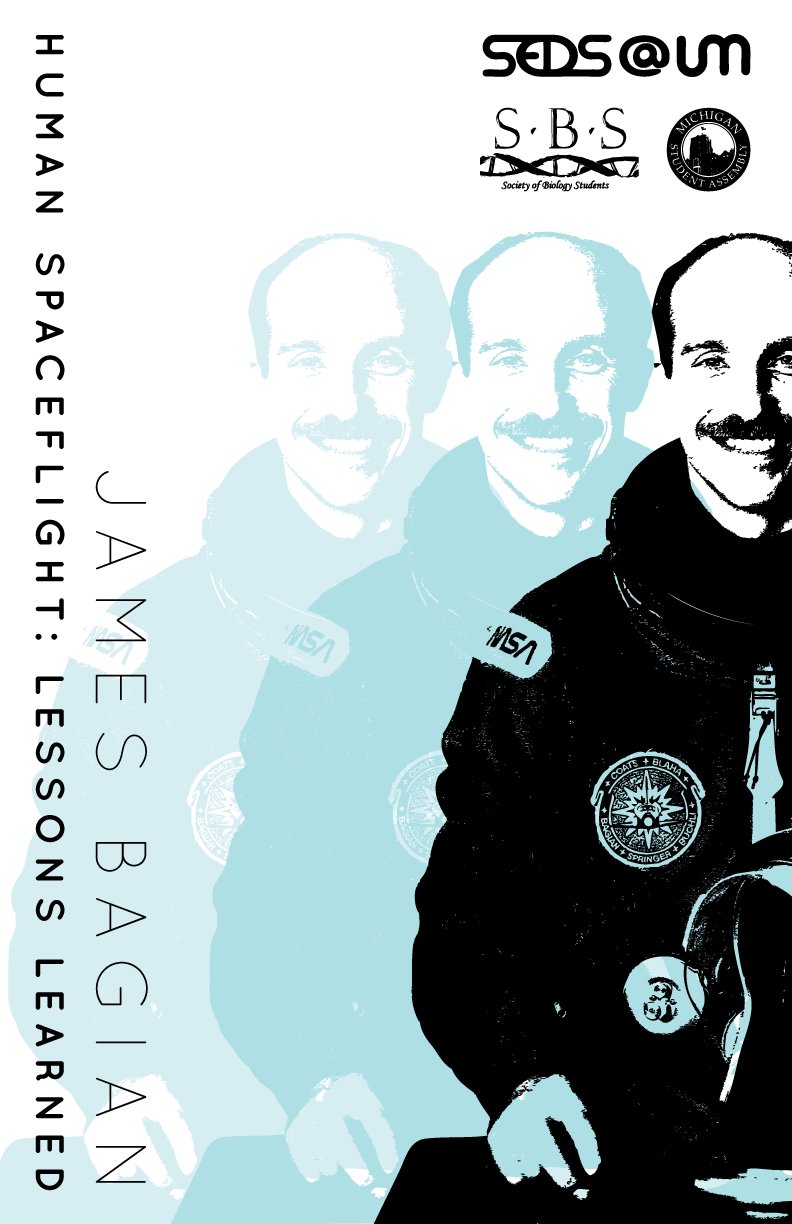
The Space Shuttle Program flew 135 orbital flights while sustaining only 2 vehicle and crew losses. In order to achieve this record of reliability NASA had numerous organizational/engineering systems in place which were continually re-examined and modified as new information became available. Lessons learned from the Challenger and Columbia mishaps will be discussed and their implications for future manned spaceflight operations.
For those of you that haven't seen it yet, the following is an amazing time-lapse video made from pictures taken on the ISS up until sun rise. There is a glow that appears 'inches' above the Earth which is the atmosphere, light from cities as the ISS traverses silently, and even lightning from storms on the surface. I hope you enjoy this as much as I did!
http://www.universetoday.com/88998/amazing-timelapse-video-from-the-space-station/
- Chase
by: Veronica Benitez - Thermal Engineering Intern at Goddard Space Flight Center and MEng Student
This summer I had the opportunity to work at NASA Goddard Space Flight Center. I interned in the Thermal Engineering branch and worked with the thermal team of the Global Precipitation Measurement (GPM) satellite. Working in the Thermal Engineering Branch has been an incredible learning experience. Aside from my primary project, I was able to work on many important tasks that a thermal engineer would complete in a typical work day including both analysis and testing.
On the thermal analysis and modeling side, I gained familiarity with the software used at GSFC mainly Thermal Desktop and SINDA Fluint. I was able to work with Thermal Desktop in tutorials and real thermal problems. I used SINDA Fluint to create the multiple cases of my primary project.
On the integration and testing side, I created multiple Work Order Authorization forms and helped test real flight hardware. I was put in charge of a thermal blanket bakeout for GPM Multilayer Insulation blankets as well as a Chotherm bakeout. I created the Work Order Authorization forms for both, made sure they were approved by the Quality Assurance Engineers as well as the Contamination Engineers. I was able to contribute to the thermal vacuum testing of the solar array drive assembly (SADA) by attending shifts to monitor the temperature of the chamber and the various components of the SADA. I also helped install thermocouples on the avionics module of the GPM satellite and route them to the proper location for connection.
My primary project at GSFC was the statistical analysis of the thermal margins of the GPM spacecraft. The average spacecraft designed at GFSC is proposed to last three to four years; however, the majority of these spacecraft are consistently lasting anywhere from ten to fifteen years. The result of the longer spacecraft life may be due to overdesign by assuming accumulated worst case scenarios. The purpose of my study is to assess the degree of margin and conservatism in the GPM thermal design that may be masked by designing to stacked, worst case conditions. The assessment contains the analysis of how the temperature and heater power of the critical spacecraft components vary over the lifetime of the spacecraft when four different variables are adjusted: power dissipation, optical properties, beta angle, and seasonal flux.
A distribution plot of the temperature ranges was created to analyze what percent of the mission lifetime the spacecraft critical components will spend at various margin ranges from operational. The impact of conservatism on each of the four variables can be studied independently to evaluate how much margin is absorbed or generated by using the extreme variables instead of nominal values. The end result of this study will be a way of quantifying the degree of conservatism in the GPM Observatory thermal design based on the traditional design approach used by the GSFC Thermal Branch.
by: Jimmy Gawron – Systems Engineering Intern at Orbital Sciences Corporation and MEng Student
This summer I had the awesome opportunity of working at Orbital as a systems engineering intern. I worked in the Science and Technology Business Development group where I was responsible for the technical design of spacecraft buses and end-to-end space missions for several NASA proposals. This involved the first order sizing of the spacecraft bus to accommodate payload requirements, the design of the communications architecture, and determination of the mission operations. I was given a lot of responsibility on high profile ventures, which provided for an exciting summer. I found Orbital’s work environment to be very high energy, and the internship helped to enhance my engineering and team working skills.